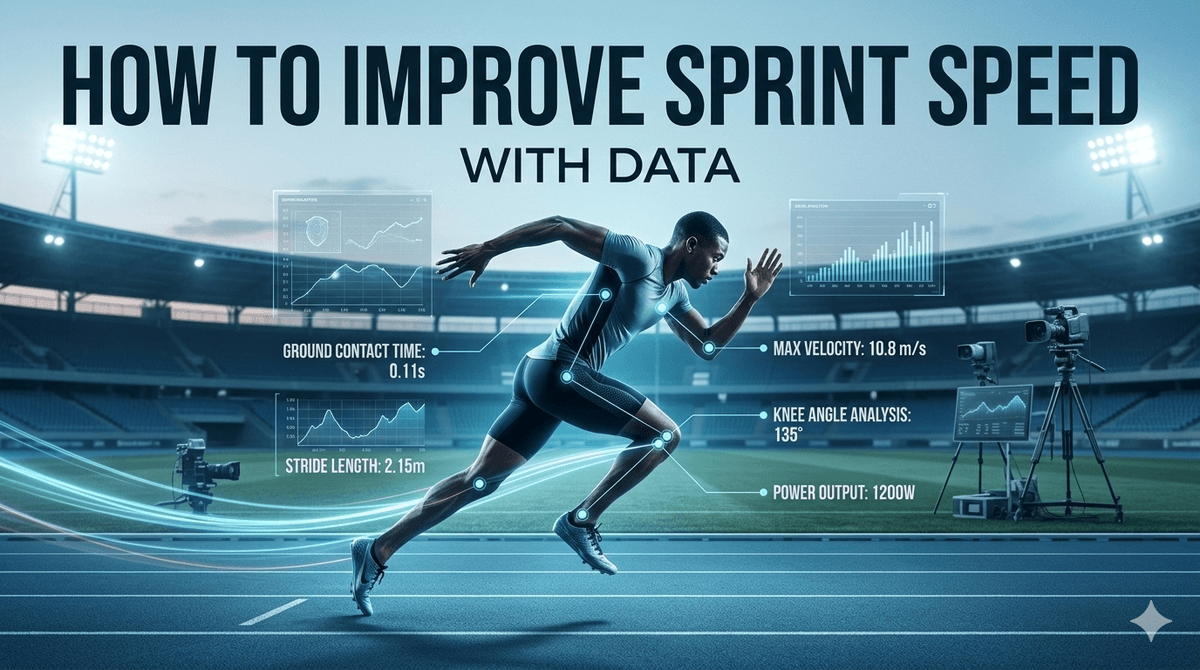
You've uploaded your sprint video. The AI has finished processing. And now you're looking at a screen full of numbers, scores, and biomechanical terms.
What does it all actually mean?
This guide walks you through every metric in your SpeedTrackr sprint analysis — what it measures, what a good number looks like, and most importantly, what to do if yours isn't where it should be.
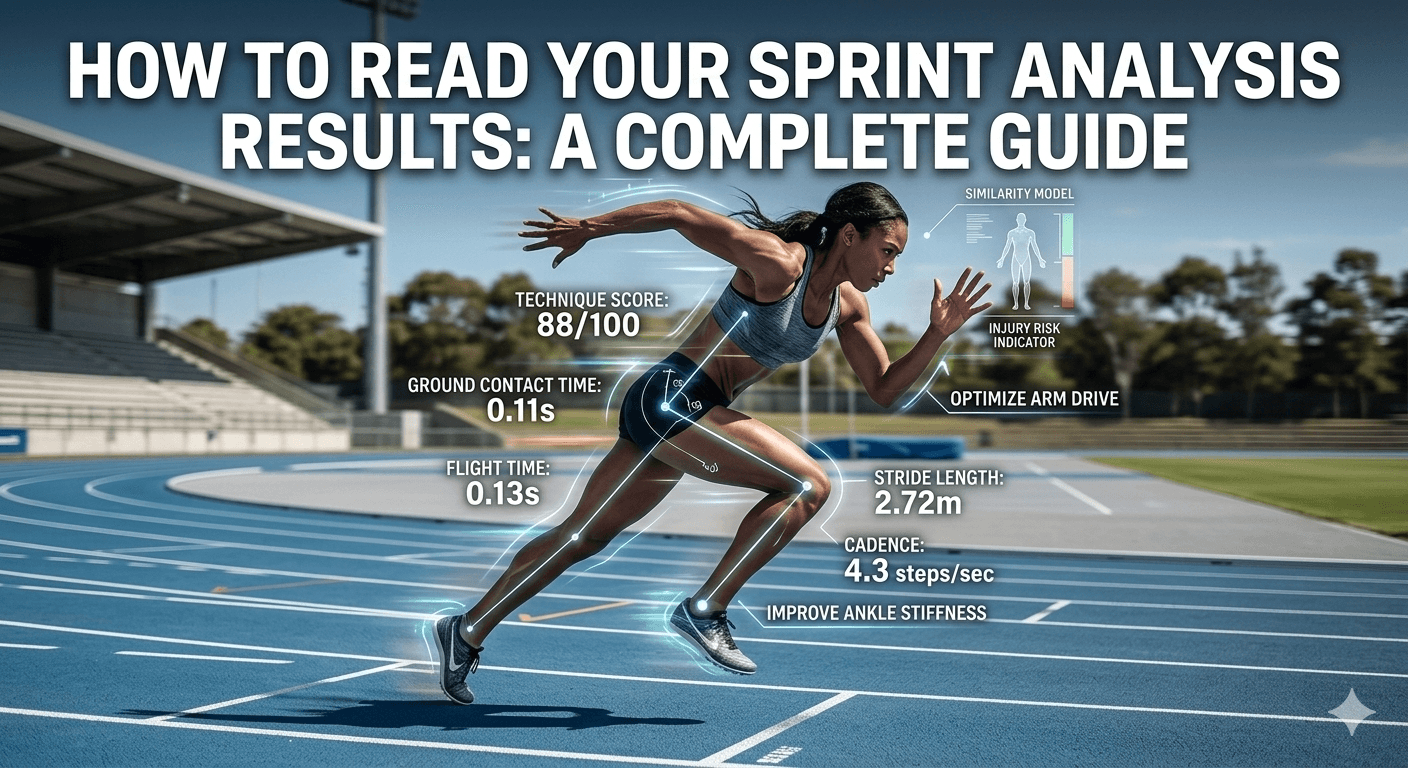
Your Technique Score
What it is: An overall score out of 100 that reflects the biomechanical efficiency of your sprint mechanics across the entire run.
What it measures: The technique score is a composite of multiple factors — your posture, arm drive, hip position, foot strike pattern, and body alignment across each phase of your sprint.
What to expect:
- 80–100: Excellent mechanics, close to optimal efficiency
- 60–79: Good foundation with specific areas to address
- 40–59: Clear mechanical inefficiencies that are costing you speed
- Below 40: Significant technique work needed before focusing on fitness gains
What to do with it: Don't be discouraged by a low first score — it's your baseline, not your ceiling. Identify which phase of your sprint (acceleration, maximum velocity, or deceleration) is dragging your score down and target that phase specifically in training.
Ground Contact Time (GCT)
What it is: The duration in seconds that your foot is in contact with the ground during each stride.
What it measures: How quickly you can apply force and leave the ground. Shorter ground contact time means more elastic energy return and faster speed.
What to expect:
- Below 0.10s: Elite level — world class sprinters at maximum velocity
- 0.10–0.13s: Strong — competitive club and collegiate level
- 0.13–0.16s: Average — room for meaningful improvement
- Above 0.16s: High priority to address — this is likely your primary speed limiter
What to do with it: High GCT usually means insufficient ankle stiffness or poor elastic energy return. Add pogo jumps, ankle stiffness drills, and single-leg reactive bounding to your training. Retest after three weeks of focused work and look for a 0.01–0.02s improvement.
Flight Time
What it is: The duration in seconds that both feet are off the ground between strides.
What it measures: Flight time reflects the power and projection angle of each stride. Too little flight time suggests insufficient power output. Too much can indicate overstriding or poor ground mechanics.
What to expect:
- 0.10–0.13s at maximum velocity is typical for well-trained sprinters
- Flight time should increase as you move from acceleration into maximum velocity phase
What to do with it: Look at the ratio between your GCT and flight time. Ideally, flight time should be equal to or greater than ground contact time at maximum velocity. If your GCT is significantly higher than your flight time, power development and stiffness work should be your priority.
Stride Length
What it is: The distance covered in a single stride, measured in meters.
What it measures: How much ground you cover with each step. Stride length is determined by the power and direction of force application — not by how far forward you reach with your foot.
What to expect:
- 2.0–2.3m: Developing level
- 2.3–2.6m: Competitive level
- Above 2.6m: Advanced — elite male sprinters can reach 2.8–3.0m at maximum velocity
What to do with it: If your stride length is low, resist the temptation to reach forward with your foot — this actually slows you down by increasing braking force. Instead, focus on hip extension power and forward projection. Bounding drills and heavy sled work develop stride length correctly.
Stride Frequency (Cadence)
What it is: The number of strides you take per second, also called cadence.
What it measures: How quickly your legs cycle through each stride. Speed is the product of stride length multiplied by stride frequency — improving either one improves your overall velocity.
What to expect:
- Below 3.5 strides/second: Low cadence — focus on turnover speed
- 3.5–4.2 strides/second: Competitive range
- Above 4.5 strides/second: Elite level — Usain Bolt averaged 4.5 at maximum velocity in his 9.58s world record
What to do with it: Low cadence often comes from spending too long on the ground (high GCT) or inefficient leg recovery mechanics. Fast leg drills, A-skips at high tempo, and wicket runs are the most effective tools for improving cadence.
Similarity Score
What it is: A percentage score reflecting how closely your mechanics resemble an optimal sprint model.
What it measures: Overall movement pattern similarity — are your joint positions and sequencing matching the biomechanical model of efficient sprinting?
What to expect: Most athletes score between 40–70% on their first analysis. This is normal. The similarity score improves as technique improves.
What to do with it: Use this alongside your technique score. If your technique score is high but similarity is low, your mechanics are efficient but unconventional. If both are low, fundamental technique work is the priority.
Biomechanical Assessment
Below your scores, SpeedTrackr provides a written biomechanical assessment — a plain-language breakdown of your primary limiting factors, what they mean for your performance, and what to do about them.
How to read it: Focus on the primary bottleneck identified first. Trying to fix everything at once is the most common mistake athletes make after their first analysis. Pick one issue, work on it for two to three weeks, then retest.
Injury Risk Indicators
What it is: A visual map highlighting asymmetries and movement patterns associated with elevated injury risk.
What it measures: Arm swing asymmetry, foot strike irregularities, hip instability, and other markers that research has linked to injury risk in sprinters.
What to do with it: Take this section seriously even when you feel fine. Most sprint injuries — hamstring strains especially — develop from movement asymmetries that are visible long before the injury occurs. If SpeedTrackr flags a moderate or high risk indicator, address it with targeted prehabilitation work before increasing training intensity.
Speed Projections
What it is: An estimated potential time based on your current biomechanical profile.
What it measures: If your mechanics were optimized — GCT reduced, technique score improved — what time would your current fitness level allow?
What to do with it: Use the speed projection as a goal, not a guarantee. The gap between your current time and your projected potential is your improvement runway. The bottleneck identified below the projection is the most direct path to closing that gap.
Your Training Journey
At the bottom of your results, SpeedTrackr generates a training block based on your specific analysis — drills and progressions targeted at your identified weaknesses, not a generic training plan.
Follow the training block between sessions. Then retest.
That comparison between your first and second analysis is where SpeedTrackr becomes a progression system rather than a single data point.
The Most Important Thing
A single analysis tells you where you are. Two analyses tell you if you're improving.
The most valuable thing you can do after reading your results is book your next sprint session. Set a specific date two to three weeks out, do the recommended training work, and come back to retest.
That's the loop. And that's where real improvement lives.
Ready to run your first analysis? Try Sprint Technique Analysis free — no equipment needed, just your phone and a sprint video.
Put it into practice.
Turn this insight into numbers — time your sprints, measure your jumps, and track your reaction time with SpeedTrackr for Android.
Free 4-week sprint plan.
Join the weekly sprint newsletter and get a research-backed 100m training blueprint — acceleration, max velocity, plyometrics, and speed endurance. Instant download.
Weekly, no spam. Unsubscribe anytime.