Anyone who’s ever stood on a track at 6:00 AM knows the feeling. You’ve given the same cue five times. You’ve demonstrated the movement until your own knees ache. But for the athlete staring back at you, the message isn't landing. They think they’re hitting the right angles, but their body is telling a different story.
This is the "Wall of Subjectivity"—the invisible barrier where a coach’s verbal instruction meets an athlete’s somatic perception. And it’s where even the most seasoned coaches lose hours of productive training time.
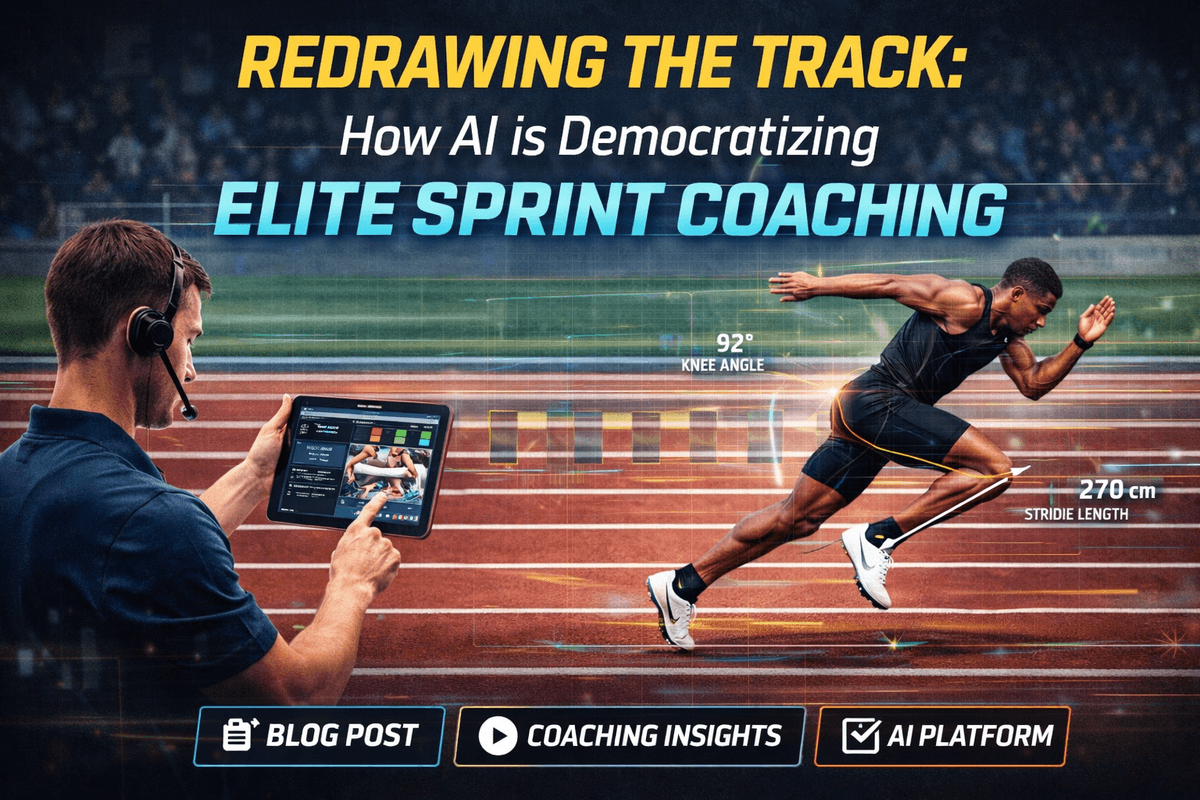
At SpeedTrackr, we didn't build our Form Overlay tool to replace the "coach’s eye." We built it to give that eye a superpower: the ability to turn a feeling into a fact using AI video analysis.
From "I Think" to "I See": The Rise of AI Form Analysis
For decades, biomechanical analysis was a luxury reserved for Olympic training centers with six-figure budgets. If you wanted to know your exact knee flexion during the mid-stance phase, you needed a lab, a dozen infrared cameras, and a PhD in sports science.
Our form overlay technology changes that. By leveraging real-time AI-powered form analysis (utilizing MoveNet pose detection), we’ve brought the lab to your smartphone. When you upload a clip, the AI identifies 17 key biomechanical markers—shoulders, hips, knees, and ankles—superimposing a digital skeleton that follows the athlete’s every move. This markerless motion capture allows for elite-level data at a fraction of the cost.
But it’s not just about the lines. It’s about the truth they reveal through automated sports performance analysis.
The Truth Serum: Joint Angles & Biomechanical Data
Why do we care about a digital skeleton? Because it reveals technical flaws that are too fast for the human eye to catch in real-time.
Take the knee angle at touchdown. If an athlete is overstriding, their knee is often too straight, leading to high braking forces and potential injury. In the heat of a session, you might just see a "heavy" step. With the AI video overlay, you see a specific 165-degree angle that screams for a correction.
When you show an athlete that number—when they see their own skeleton struggling against the physics of the track—something clicks. That’s the "Aha!" moment. The debate ends, and the motion analysis for coaches begins.
Scaling Your Impact with Automated Feedback
The biggest challenge for any growing coaching business is time. How do you provide elite-level, personalized feedback to 30 athletes without burning out?
- Instant Visual Syncing: Stop spending 20 minutes explaining. Spend 2 minutes showing. The visual feedback loop created by AI-driven motion analysis is 10x faster than verbal cues alone.
- Objective Progress Tracking: "You look better today" is nice. "Your hip height is up by 4cm and your ground contact time is down by 8ms" is progress you can bank on using sports performance data.
- Asynchronous Coaching & Remote Training: With our mobile-first workflow, your athletes can record their sessions in London while you perform video analysis from Los Angeles. You can scrub through their form, download a snapshot of a critical flaw, and send it back with a targeted drill—all before your morning coffee.
The Future of the "Coach's Eye"
Some fear that AI will make the coach obsolete. We believe the opposite. Technology like the AI Form Overlay tool strips away the guesswork, allowing you to focus on what you do best: building the human athlete.
By democratizing sports biomechanics software, we aren't just making athletes faster; we're empowering coaches to lead bigger squads, produce better results, and finally bridge the gap between intuition and evidence with AI-powered sports technology.
Ready to see what your athletes are really doing? Head over to the Coach Form Overlay and upload your first clip today.
Put it into practice.
Turn this insight into numbers — time your sprints, measure your jumps, and track your reaction time with SpeedTrackr for Android.
Free 4-week sprint plan.
Join the weekly sprint newsletter and get a research-backed 100m training blueprint — acceleration, max velocity, plyometrics, and speed endurance. Instant download.
Weekly, no spam. Unsubscribe anytime.