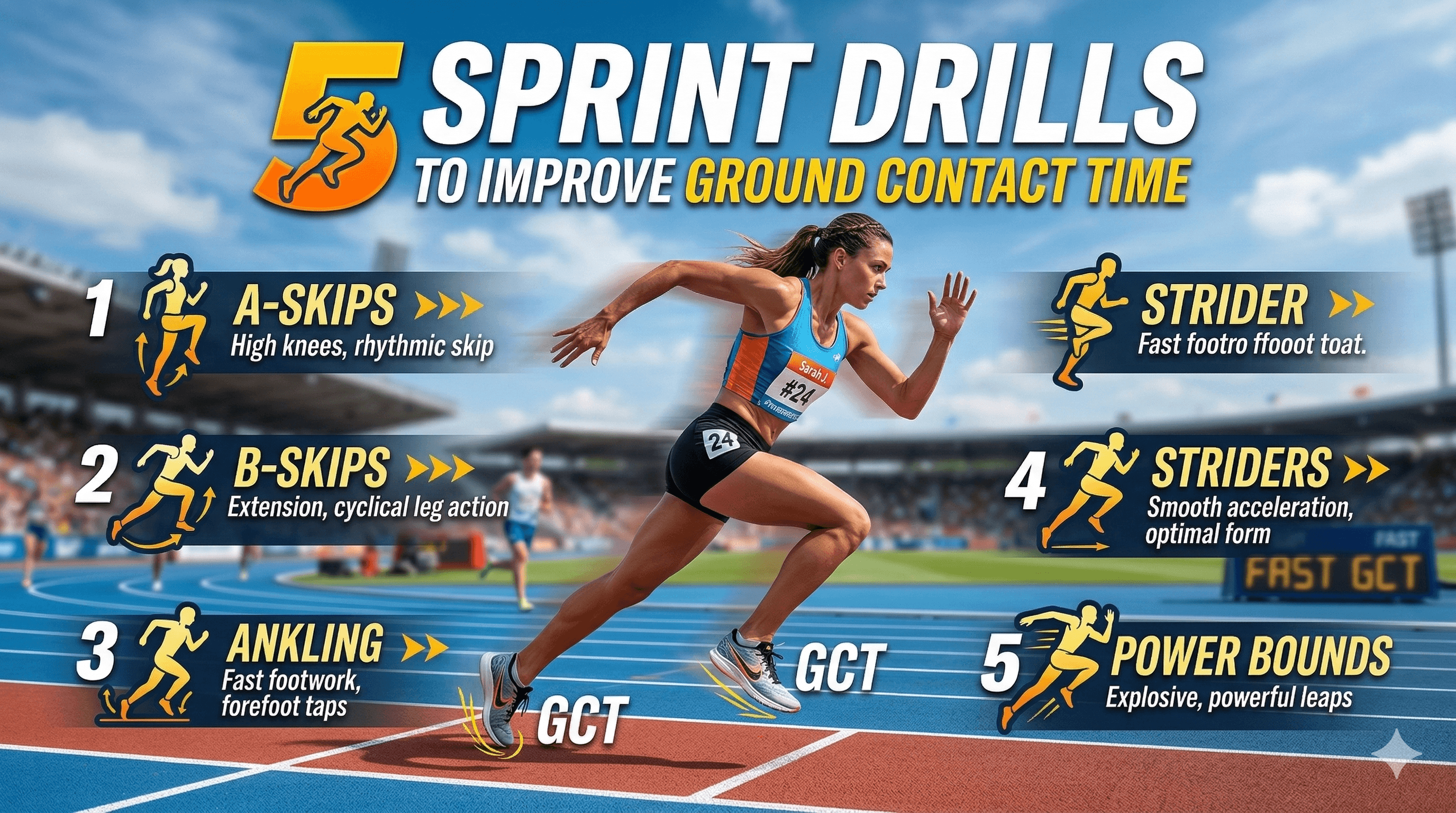
If you could change one thing about your sprint mechanics to immediately run faster, it would be this: spend less time on the ground.
Ground Contact Time — the duration your foot is in contact with the track during each stride — is the single most influential metric in sprint performance. And unlike stride length or maximum velocity, it is also one of the most directly trainable.
Elite sprinters at maximum velocity spend less than 0.10 seconds on the ground per stride. Most amateur athletes spend 0.14–0.18 seconds. That gap doesn't sound dramatic. But over 100 meters, it is the difference between finishing and winning.
Here are five drills that directly target GCT — and how to know whether they're actually working.
Why Ground Contact Time Matters So Much
Speed is simple physics. The faster you can apply force into the ground and leave it, the faster you move horizontally. Every extra millisecond your foot spends on the ground is a millisecond you are not moving forward at maximum velocity.
High GCT usually means one or more of the following:
- Insufficient ankle stiffness — the foot collapses on contact rather than rebounding
- Poor elastic energy return — muscles absorbing force rather than returning it
- Overstriding — foot landing too far in front of the center of mass
- Weak posterior chain — hamstrings and glutes failing to cycle the leg through quickly
The five drills below each target one or more of these causes directly.
Drill 1 — Pogo Jumps
What it is: Rapid two-footed jumps with minimal knee bend, focusing on ankle stiffness and ground contact speed.
How to do it:
- Stand tall with feet hip-width apart
- Jump continuously, keeping knees almost straight
- Focus on spending as little time on the ground as possible
- Arms stay relaxed at your sides
- Target: 3 sets of 20 contacts, rest 90 seconds between sets
Why it works: Pogo jumps directly train ankle stiffness — the primary mechanical driver of short GCT. The goal is to treat the ground like a hot surface. The shorter the contact, the better the training stimulus.
Progression: Once comfortable with two feet, progress to single-leg pogo jumps. The single-leg version is significantly harder and closer to the demands of actual sprinting.
Drill 2 — A-Skip with Fast Foot
What it is: A variation of the classic A-skip drill with an added focus on rapid foot withdrawal after ground contact.
How to do it:
- Perform standard A-skips — high knee drive, opposite arm swing
- On each ground contact, actively claw the foot back toward your body immediately after landing
- Do not let the foot linger — think "touch and go"
- Target: 4 sets of 20 meters, focusing on contact speed not distance covered
Why it works: The A-skip builds the correct leg cycle mechanics. Adding the fast foot emphasis trains your nervous system to withdraw the foot rapidly — directly reducing contact duration without sacrificing force application.
Common mistake: Reaching the foot forward on landing. This increases braking force and GCT simultaneously. The foot should land under or slightly behind the center of mass.
Drill 3 — Wicket Runs
What it is: Running over evenly spaced hurdles or cones placed at a fixed stride distance, forcing rapid leg cycling and controlled contact time.
How to do it:
- Place wickets or small hurdles 1.0–1.2 meters apart (adjust based on your stride)
- Run through at 80–90% effort, stepping between each wicket
- Focus on quick, light ground contacts — do not pound through the wickets
- Target: 6 runs of 20 meters, 2 minutes rest between runs
Why it works: The spacing forces a specific stride frequency that demands short GCT. Athletes naturally adjust their mechanics to clear the wickets cleanly — which means faster contacts and higher cadence without being consciously instructed to do so.
Progression: Gradually reduce the spacing between wickets to force even faster leg cycling and shorter contact times.
Drill 4 — Bounding with Stiff Ankles
What it is: Exaggerated single-leg bounding where each contact is made with a stiff, plantar-flexed ankle rather than a soft heel strike.
How to do it:
- Push off one leg into a long, powerful bound
- On landing, keep the ankle stiff — no heel contact
- Immediately drive back off the ground into the next bound
- Arms work aggressively to generate momentum
- Target: 4 sets of 8 bounds per leg, 2 minutes rest
Why it works: Bounding develops both power and stiffness simultaneously. The stiff ankle cue forces athletes to use elastic energy return rather than muscular force alone — which is exactly how elite sprinters generate speed efficiently.
Key metric to watch: The sound of your contact. Soft, quiet contacts mean good stiffness. Loud slapping contacts mean the ankle is collapsing.
Drill 5 — Resisted Sprint Releases
What it is: Short sprint efforts using a resistance band or sled, followed by an immediate unresisted sprint — creating a contrast effect that reinforces fast ground contacts.
How to do it:
- With a partner holding a resistance band around your waist, sprint 15 meters against resistance
- Immediately upon release, sprint an additional 20 meters at maximum effort
- The unresisted phase should feel effortless compared to the resisted phase
- Target: 5 sets, 3 minutes rest between sets
Why it works: Resisted sprinting forces higher force application per contact. When the resistance is removed, your nervous system briefly maintains the same force output — which at lower resistance translates to shorter, more powerful contacts. This neurological contrast effect is one of the most effective methods for improving sprint mechanics rapidly.
Important: Keep resistance moderate. Heavy resistance changes mechanics negatively. The goal is slight overload, not complete breakdown of form.
How to Know If These Drills Are Working
Here is the problem with most drill programs: athletes do the work but never measure the outcome.
You can perform pogo jumps every session for six weeks and have no idea whether your GCT has actually changed. Without measurement, you are training on faith rather than evidence.
Ground Contact Time should be measured before you start this program and retested every two to three weeks. A reduction of even 0.01–0.02 seconds represents meaningful improvement and confirms your training is working. If your GCT isn't moving after three weeks of focused drill work, something in your execution needs to change.
Time the same fly or acceleration distance with SpeedTrackr timing gates before you start this program, then retest after three weeks. If the clock does not move, something in your execution needs to change. Dedicated GCT systems still belong in a lab when you need that specific millisecond.
Programming These Drills
For best results, incorporate these drills in the following order within a training week:
- Pogo jumps and A-skips — warm-up phase, before main sprint session
- Wicket runs — technical phase, after warm-up and before maximum velocity work
- Bounding — power phase, two sessions per week maximum
- Resisted sprint releases — speed phase, once per week as a contrast session
Allow 48–72 hours of recovery between bounding and resisted sprint sessions. These are high-intensity neural activities and require adequate recovery to produce adaptation.
The Bottom Line
Ground Contact Time is not fixed. It responds to training. And unlike many athletic qualities, it can improve meaningfully within three to four weeks of targeted drill work.
The athletes who improve fastest are not always the ones who train hardest. They are the ones who train with a specific target, measure their progress honestly, and adjust when the numbers tell them something isn't working.
Pick one drill from this list. Do it consistently for three weeks. Measure your GCT before and after.
Then come back and tell us what changed.
Want a practice clock on the track? Try dual-phone timing gates — free to start in the Android app.
Put it into practice.
Turn this insight into numbers: time your sprints, measure your jumps, and track your reaction time with SpeedTrackr for Android.
Free 4-week sprint plan.
Join the weekly sprint newsletter and get a research-backed 100m training blueprint: acceleration, max velocity, plyometrics, and speed endurance. Instant download.
Weekly, no spam. Unsubscribe anytime.