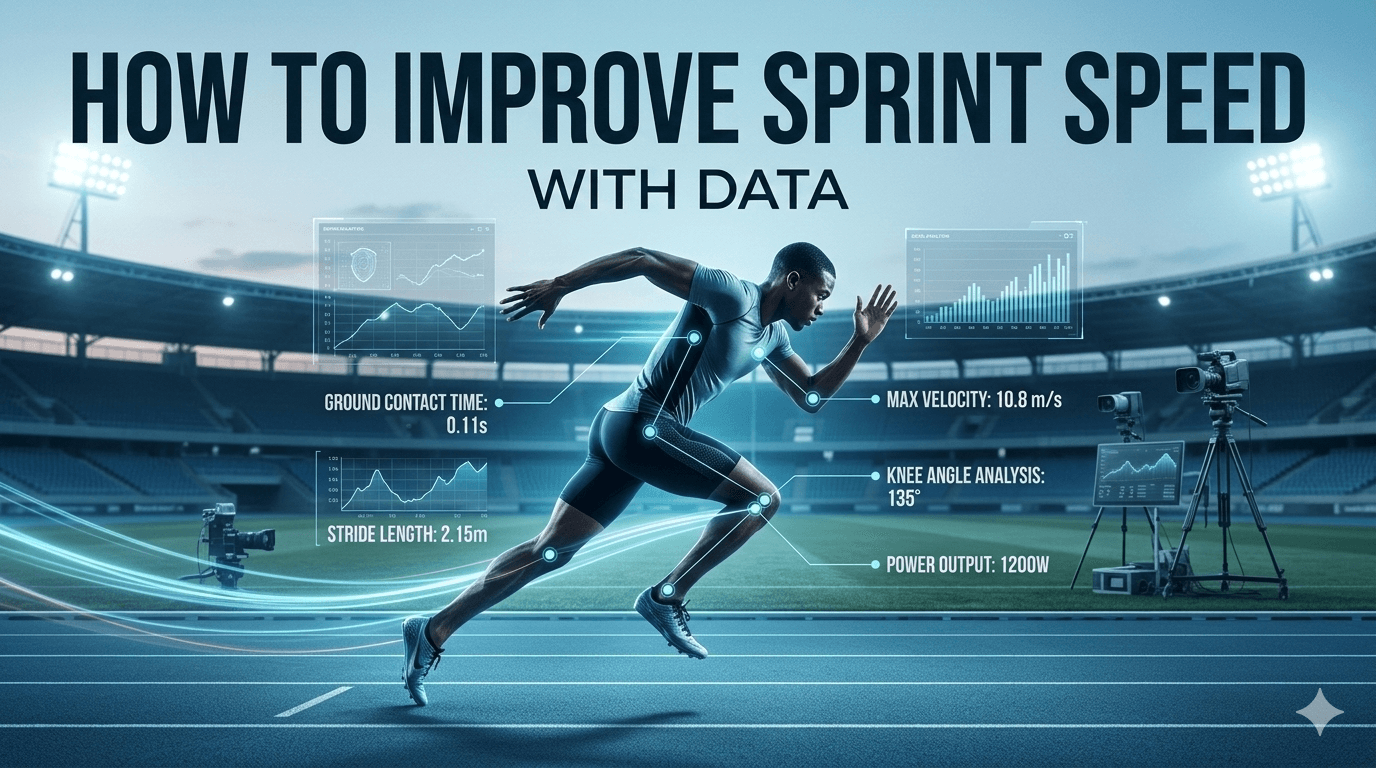
Most sprinters follow the same cycle: train hard, race, repeat. But without data, this cycle often leads to the same plateau working harder without knowing why results aren't improving.
The difference between an athlete who progresses consistently and one who stagnates isn't always talent or effort. It's feedback.
Elite sprinters at national training centers have always had access to biomechanical data frame-by-frame breakdowns, force measurements, reaction timing. That feedback loop is what accelerates improvement. And until recently, it was completely inaccessible to the average athlete.
This guide breaks down the specific data points that matter most for sprint performance and how to actually use them to improve.
The Four Metrics That Drive Sprint Speed
1. Ground Contact Time (GCT)
Ground Contact Time is how long your foot stays on the ground during each stride, measured in seconds.
- Why it matters: The faster you can apply force and leave the ground, the faster you move. Elite sprinters at maximum velocity spend as little as 0.08s on the ground. Most amateur athletes spend 0.15s or more nearly double.
- What to look for: A GCT above 0.13s at maximum velocity is a clear signal that your stiffness and elastic energy return need work.
- How to improve it: Pogo jumps, ankle stiffness drills, and reactive bounding exercises directly target GCT reduction. Even a 0.02s improvement in GCT translates to measurable speed gains over 100m.
2. Stride Frequency vs. Stride Length
Speed is a product of two things: how long each stride is and how many strides you take per second. The mistake most athletes make is chasing one at the expense of the other.
- Why it matters: Increasing stride length by overreaching actually slows you down it increases braking force and GCT. True stride length improvement comes from hip extension and power, not reaching forward.
- What to look for: Track both metrics across sessions. If stride length is increasing but frequency is dropping, you may be overstriding.
- How to improve it: Wicket runs and A-skip progressions teach the correct combination of length and frequency without encouraging overstriding.
3. Reaction Time
Your sprint doesn't start at the gun it starts in your nervous system. Reaction time is the gap between the stimulus and your first movement.
- Why it matters: In a 100m race, 0.1s of reaction time difference between two athletes of equal speed means 1 meter at the finish line. At the high school and collegiate level, races are often decided by reaction alone.
- What to look for: Consistent reaction times below 0.15s are a strong foundation. High variability between sessions often signals fatigue or poor neural readiness.
- How to improve it: Regular reaction training with random stimulus not predictable countdowns forces your nervous system to adapt. Tracking your reaction time over weeks shows whether your training is actually improving neural speed.
4. Technique Score and Biomechanical Efficiency
Raw power without efficient mechanics is wasted energy. Technique score captures how well your body position, arm drive, and posture align with efficient sprint mechanics across your entire run.
- Why it matters: Two athletes with identical strength and fitness profiles can have vastly different sprint times based purely on mechanics. Poor arm swing, low hips, or early upright posture in the acceleration phase all drain speed.
- What to look for: Consistently low scores in specific phases acceleration, maximum velocity, or deceleration pinpoint where your mechanics break down.
- How to improve it: Drill work targeted at the specific phase where your score drops. Wall drills for acceleration mechanics, tall sprint holds for max velocity posture, and wickets for deceleration control.
The Problem With Training Without Data
Here is the hard truth: without tracking these metrics across sessions, you cannot tell whether you are actually improving or just feeling like you are.
Perceived effort is unreliable. A session that feels great might show no measurable improvement. A session that feels terrible might reveal a personal best in GCT.
The body adapts in ways that aren't always visible from the inside. Data gives you an objective view that your perception never can.
How to Build a Data-Driven Training Loop
The most powerful use of performance data isn't a single analysis it's the pattern across multiple sessions. Here is a simple framework:
Step 1 Establish your baseline Run a timed sprint and capture your full biomechanical profile. This is your starting point. Every metric you see is your current reality, not a judgment.
Step 2 Identify your primary bottleneck Look at your times and find the single number furthest from where you want to be. For most athletes this is either a slow first 10m or a slow fly. Focus here first.
Step 3 Target your training For 2–3 weeks, run drills and sessions specifically designed to improve your bottleneck metric. Not general fitness work targeted, specific work.
Step 4 Retest and compare Run the same sprint test under similar conditions and compare your new time against your baseline. This is where data becomes motivating — seeing a 0.05s drop on the same mark confirms that your training is working.
Step 5 Repeat with the next bottleneck Once one metric improves, move to the next limiting factor. This iterative loop is how consistent, measurable progression is built.
[!TIP] Performance Benchmarks: Want to see how your metrics compare to elite standards?
The Compound Effect of Marginal Gains
A 0.05s faster reaction time. A quicker 10m. A faster fly on the same mark.
None of these feel dramatic in isolation. But combined across a full 100m sprint, marginal improvements in multiple metrics stack into significant time drops. This is precisely why data-driven athletes improve faster they aren't chasing vague "better training." They are targeting specific, measurable numbers and moving them in the right direction.
Start With One Sprint
You don't need a lab. You don't need a coach with a force plate. You need a phone, a track, and a willingness to look at the data honestly.
Time a practice run with dual-phone timing gates so you can see whether the work actually moved your sprint time. Technique scores and lab-style GCT still belong to motion-capture setups — SpeedTrackr is the pocket clock and jump/VBT lab on Android.
Then run it again in two weeks.
That gap between the two sessions is where improvement lives.
Ready to time a practice run? Get the Android app — free to start.
Put it into practice.
Turn this insight into numbers — time your sprints, measure your jumps, and track your reaction time with SpeedTrackr for Android.
Free 4-week sprint plan.
Join the weekly sprint newsletter and get a research-backed 100m training blueprint — acceleration, max velocity, plyometrics, and speed endurance. Instant download.
Weekly, no spam. Unsubscribe anytime.