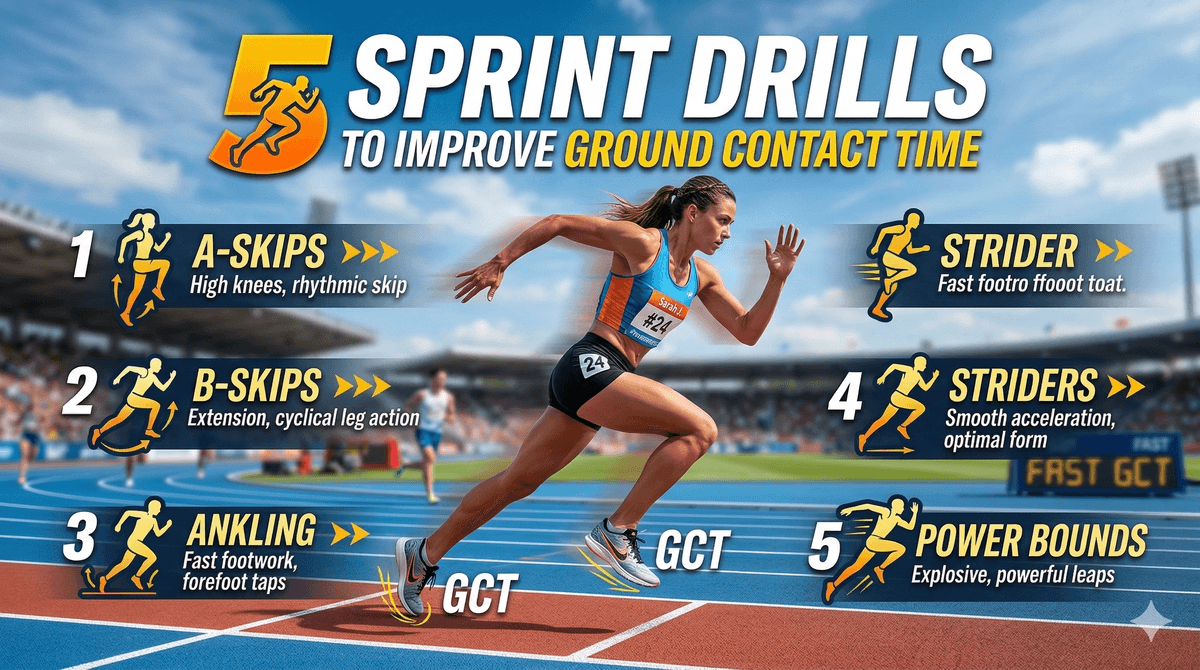
If you want to sprint faster, you don’t need to start by obsessing over your knees or hips.
Start lower.
Your ankle is the last big “translator” between your body and the ground. It decides how much force actually makes it into the track, how quickly you can apply it, and how much speed you lose every step.
This article breaks down what your ankle mechanics reveal about your sprint speed, what “good” looks like, and how to fix the common problems that keep athletes stuck.
The ankle’s real job in sprinting
In sprinting, the ankle isn’t just a joint that moves.
It’s a spring.
When your foot hits the ground, your ankle complex (joint + Achilles tendon + calf muscles) should:
- Accept load quickly
- Store elastic energy
- Release it back into the ground with minimal delay
The best sprinters don’t “push” the ground for a long time. They hit, load, and bounce.
That’s why the ankle shows up in two performance signals that matter more than almost anything:
- Ground contact time (how long you’re on the ground)
- Stiffness (how well you resist collapse and rebound)
[!TIP] Measure your bounce: You can track your ground contact time and reactive strength using the Vertical Jump Analysis tool.
If your ankle collapses, your speed leaks
One of the biggest speed-killers is an ankle that collapses too much on contact.
It can look like:
- The heel drops aggressively
- The shin rolls forward too far over the foot
- The foot lands and stays “flat” too long
What that usually means:
- You’re losing time on the ground
- Your calf/Achilles isn’t returning energy efficiently
- Your body has to “muscle” the step instead of bouncing off the track
A small amount of dorsiflexion (shin moving forward) is normal. But excessive collapse turns a spring into a shock absorber.
What your ankle angle is telling you
In sprint video, you can usually learn a lot from 3 moments:
1) Just before contact: “Is the ankle pre-tensioned?”
Look for the foot coming into the ground with a strong, braced shape.
Good signs:
- Toes up slightly (dorsiflexed)
- Foot looks rigid, not floppy
- The athlete looks like they’re about to “tap” the ground
Red flags:
- Toes pointing down (plantarflexed) like you’re reaching for the ground
- Foot looks loose
- The ankle looks unprepared to take load
Why it matters: A pre-tensioned ankle can handle force fast. A floppy ankle needs extra time to “find stiffness” after contact.
2) Mid-stance: “Does the ankle stay tall?”
This is where speed either stays or disappears.
Good signs:
- Minimal heel drop
- Shin doesn’t drift excessively forward
- You rebound out quickly
Red flags:
- Big heel drop
- A long “sink” phase
- The body looks like it’s sitting into the step
[!IMPORTANT] Check your bounce: Time the same fly or acceleration distance with dual-phone timing gates after ankle-stiffness work so you can see whether the bounce showed up in the clock.
3) Toe-off: “Do you finish the step without pushing too long?”
A lot of athletes think sprinting is about pushing the ground hard. But when you push too long, you slow down.
Good signs:
- Quick release
- You leave the ground cleanly
- The leg cycles through smoothly
Red flags:
- Long extension behind the body
- You look like you’re driving the track backward
- The foot stays on the ground as the body moves past it
The speed formula your ankle influences
Sprinting speed can be simplified to: Step length × Step frequency
Your ankle influences both.
If your ankle is stiff and reactive:
- Ground contact time drops
- Step frequency can climb
- You keep your hips moving forward without getting “stuck” on the ground
If your ankle collapses or you push too long:
- Contact time increases
- Frequency drops
- Your step length may look big, but it’s often “reaching” rather than propelling
Common ankle patterns (and what they usually mean)
Pattern A: Heel drops hard on contact
- Likely causes: Weak soleus, poor reactive strength, or fatigue.
- What it costs: Longer contacts and less elastic return.
Pattern B: Toes point down before contact
- Likely causes: Overstriding, poor front-side mechanics, or limited dorsiflexion control.
- What it costs: Braking forces and a slower transition.
Pattern C: You “push” behind you for too long
- Likely causes: Using force over timing, lack of "bounce," or lack of max velocity exposure.
- What it costs: Low frequency and energy waste.
[!NOTE] Analyze your pattern: Use Sprint Insights to identify which pattern is holding you back and track how your mechanics improve over a training block.
6 fixes that translate directly to sprint speed
1) Build the “quiet ankle” with pogo progressions
Pogos teach you to rebound without sinking.
Progression (2–3x/week):
- Two-leg ankle pogos: 3×20
- Single-leg pogos: 3×12 each
- Alternating pogos (fast): 3×20
2) Train the soleus (the sprint calf)
The soleus is huge for keeping the ankle stiff when the knee is bent. Try seated calf raises (3-4x15) or isometric holds at mid-range.
3) Use isometrics to teach stiffness under load
Try single-leg calf isometric holds or split squats with the front heel slightly raised.
4) Fix the “toes down” issue with sprint dribbles
Focus on "toes up" and stepping down under the hip with A-march and A-skip variations.
5) Run fast enough to force fast contacts
Include flying 10s (4-6 reps) with full rest to expose your system to true max velocity contacts.
6) Check your footwear and surface
Don't train on soft surfaces indefinitely. You need some exposure to firmer tracks to teach your ankle to rebound.
A simple self-check you can do today
Film a 10–20m fly segment from the side and ask:
- Is my foot arriving braced (toes up, rigid foot)?
- Does my heel drop a little or a lot?
- Do I rebound quickly, or do I “sit” into the step?
- Does my foot stay on the ground too long behind me?
If you see a big collapse or a long push, your ankle is telling you the same thing: You’re spending too long on the ground.
And speed lives in fast contacts.
The big takeaway
Your ankle is one of the most honest performance indicators in sprinting. A stiff, reactive ankle shortens ground contact time and improves step frequency. If you want faster sprint times, don’t just train harder. Train for bounce.
Ready to see if the bounce transferred? Time a practice run →
Put it into practice.
Turn this insight into numbers — time your sprints, measure your jumps, and track your reaction time with SpeedTrackr for Android.
Free 4-week sprint plan.
Join the weekly sprint newsletter and get a research-backed 100m training blueprint — acceleration, max velocity, plyometrics, and speed endurance. Instant download.
Weekly, no spam. Unsubscribe anytime.