If you’re trying to run a faster 100m (or you’re a coach trying to clean up an athlete’s start), you’ve probably asked this exact question:
Should I use blocks or a 3-point start?
The honest answer is: it depends on your event, training phase, access to blocks, and (most importantly) your first-step execution. Blocks can be faster at the elite level, but a great 3-point start will beat a sloppy block start every single time.
This guide breaks down the differences, who should use what, and how to decide quickly without overthinking.
High-SEO keywords covered in this post: block start vs 3 point start, block start for 100m, 3 point start sprinting, how to start a sprint, sprint start technique, acceleration mechanics, reaction time training, improve sprint start, starting blocks technique.
What’s the difference between a block start and a 3-point start?
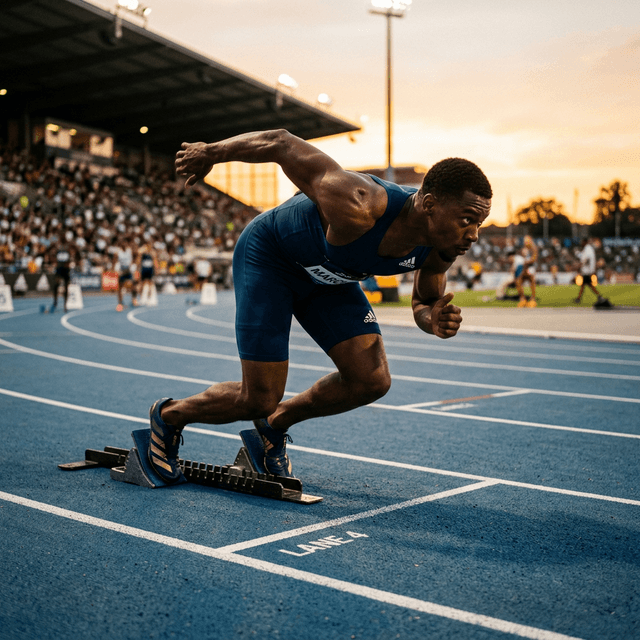
Block start:
- Uses starting blocks with both feet braced against pedals
- Hands on the track, hips high, powerful push on the gun
- Standard for 100m/200m track races
3-point start:
- No blocks
- One hand down, one hand up (hence “3 points” on the ground)
- Common in training, field sports, and athletes who don’t always have blocks
Both are “crouch-style” starts. The big difference is how force is applied in the first 1–3 steps.
Block start vs 3-point start: which is faster?
If everything is equal (strength, skill, reaction, technique), blocks usually win because:
- You can generate more horizontal force into the track immediately
- Your feet don’t slip
- You start from a more repeatable position
- The angles are optimized for a powerful push
But in real life, most athletes aren’t “equal” in execution. For many developing sprinters, a 3-point start can be just as fast (or faster) because:
- It’s simpler to set up
- Less time wasted “getting into position”
- Fewer technical breakdowns (especially hips rising too fast, over-striding, or popping up)
If you’re not consistently training in blocks, it’s hard to magically race well in blocks.
[!TIP] : Before you obsess over blocks vs 3-point, measure the thing that decides most starts: how fast you react and move on the first step.
Test your reaction time with Reaction Pro →
Retest weekly to see if your start work is actually translating.
When should you use blocks?
Use blocks if:
- You compete in the 100m/200m on the track
- You have consistent access to blocks
- You can practice block starts at least 1–2 times per week (even a few reps)
Blocks are not “optional” for serious 100m/200m racing. If your goal is a better race start, at some point you must train the exact skill.
But here’s the mistake athletes make: They treat blocks like a “special race-only thing,” so they never get comfortable. Then on race day, they’re thinking about setup instead of exploding.
When should you use a 3-point start?
Use a 3-point start if:
- You don’t have blocks available often
- You’re in early general preparation (GPP) and focusing on acceleration basics
- You play a field sport (football, rugby, soccer) and need a practical start position
- You’re rebuilding mechanics after time off or injury
A 3-point start is an excellent training tool because it teaches forward shin angles, a strong push through the ground, and a clean first-step rhythm. And you can do it anywhere.
The real decision: what start helps you train the best acceleration?
Instead of asking “which is better?” ask: Which start lets me repeat high-quality acceleration reps with great mechanics? Because acceleration improves from quality reps, consistent positions, and objective feedback (timing, video, data).
If blocks create messy reps for you right now, use 3-point in training and gradually add blocks.
[!IMPORTANT] : If your block start feels slow, don’t guess whether it’s “power” or “reaction.”
Test your reaction speed with Reaction Pro →
Run 3–5 starts and retest. If reaction improves but your first steps don’t, the issue is mechanics. If reaction is slow, you’ve discovered a clear limiter you can train.
Block start technique basics
Basic block setup (simple guideline)
- Front pedal roughly 2 foot-lengths from the start line
- Back pedal about 3 foot-lengths from the start line
- Knee angles should feel “loaded” but not cramped
Key block start cues
- Push back, not up
- Drive out low for the first 5–10m
- Eyes down, neck neutral (don’t throw your head up)
- Punch the ground behind you
- Step down and back (avoid reaching)
3-point start technique basics
3-point setup
- Front foot under or slightly behind hips (not too far forward)
- Back foot behind you, heel up
- One hand down under shoulder, other arm set back ready to drive
3-point cues
- Push the ground away
- Torso angled forward (don’t stand up immediately)
- Drive arms hard (arms help set rhythm and force)
- First steps: powerful and quick, not long and reaching
What matters more than blocks vs 3-point: reaction time
In sprinting, the start has two phases:
- Reaction: how fast you initiate movement after the signal
- Execution: how effective your first 3–10 steps are
You can improve both, but you need measurement.
Practical way to train reaction
- Use Reaction Pro to test your baseline reaction time.
- Do 2–3 short sessions per week (quick, low fatigue).
- Retest weekly and track the trend.
[!TIP] : Want a simple start-performance scorecard? Use these three metrics:
That combo tells you exactly what to fix next.
Final answer: which should you use?
If you race track sprints, you should ultimately use blocks. But you should use 3-point starts as a training weapon—especially when blocks reduce rep quality or you’re early in your season.
The goal isn’t to pick a side. The goal is a faster first 10 meters. And the fastest way to improve that is to measure what’s holding you back—reaction time, mechanics, or both—then train it with consistency.
Ready to find your weak link? Analyze your start with our Sprint Technique Analysis today.
Put it into practice.
Turn this insight into numbers — time your sprints, measure your jumps, and track your reaction time with SpeedTrackr for Android.
Free 4-week sprint plan.
Join the weekly sprint newsletter and get a research-backed 100m training blueprint — acceleration, max velocity, plyometrics, and speed endurance. Instant download.
Weekly, no spam. Unsubscribe anytime.