Reaction time is one of those performance traits athletes obsess over because it feels like the difference between winning and losing is decided in the first blink.
But when you look at the research across sprinting, starts, and training interventions, the story is more nuanced:
- Reaction time matters, but it’s not the only “start” skill.
- The best training often looks less like “gaming your reflexes” and more like improving start consistency, decision speed, and first-step mechanics.
- Measuring it correctly is half the battle.
This post breaks down what the data actually shows about reaction time training, what’s worth doing (and what’s mostly noise), and how you can measure block starts or 3-point starts accurately with just a phone camera using SpeedTrackr’s Reaction-Pro.
What “reaction time” really means (and why it gets misunderstood)
In sprinting, “reaction time” usually refers to the time between the start signal (gun/beep/"go") and the athlete’s first detectable movement.
But two things get mixed together all the time:
- Reaction time (neural decision + initiation): signal → brain processing → motor command
- Movement time (execution): motor command → body actually producing visible motion
In a race, you don’t get credit for “thinking fast” if your first movement is late or inconsistent. What coaches often care about is:
- The athlete’s time to first movement
- The athlete’s consistency across reps
- How that early movement translates into first 3 steps and acceleration position
Reaction-Pro focuses on what athletes can control and train: repeatable, measurable start response in real sprint setups.
[!IMPORTANT] : Measuring reaction time in the lab is great, but measuring it on the track is better.
What the research tends to agree on
Even though studies differ (sports, protocols, ages), a few consistent patterns show up.
1) Reaction time improves quickly… then slows down
Most athletes can improve reaction time with practice, especially early on. The biggest gains typically happen when:
- You’re new to the task
- You improve attention, cue recognition, and readiness
- You simply become more familiar with the start pattern
After that, improvements get smaller and more specific. The “easy wins” are mostly coordination + familiarity.
2) Simple “reflex drills” don’t always transfer to sprint starts
Catching a ruler, tapping a screen, random-light apps—these can improve task-specific reaction tests.
But sprint starts include:
- A specific posture (blocks or 3-point)
- A consistent pre-tension and pressure pattern
- A full-body explosive action
- A real-world cue (sound, clap, voice, beep)
So the best transfer usually comes from training reaction inside the start context.
3) Consistency is often the real performance lever
Two athletes might have similar average reaction time, but one is stable and one is volatile.
That volatility costs races and training quality because:
- You can’t dial in start mechanics if timing is random
- You can’t compare reps fairly
A training plan that reduces variance (even if the mean changes modestly) often has a bigger impact.
[!TIP] : The goal of reaction training isn't just to be "fast"—it's to be consistent. Use Reaction-Pro to track your variance over 10 reps.
What actually works for sprint reaction training
Here are methods that tend to have the best “signal-to-noise ratio” in real training.
A) Sprint-specific start reps with randomized cues
Instead of predictable “go on 3”, use variable timing.
- Set up in blocks or 3-point
- Use an audio cue (beep/hand clap/voice)
- Randomize the delay (2–6 seconds)
- Track each rep
This trains readiness without turning it into a guessing game.
B) Split your focus: reaction reps vs power reps
Mixing intentions ruins both.
- Reaction reps: slightly lower volume, high quality, full focus on cue + first movement
- Power reps: focus on pushing mechanics, projection, and first 3 steps; cue can be predictable
C) Keep the task identical if you want comparable data
If your stance changes every rep, your “reaction time” measurement becomes a posture experiment.
To track progress:
- Same start type (blocks or 3-point)
- Same camera angle
- Same cue type
- Same surface and shoes (as much as possible)
The measurement problem: why athletes get bad reaction data
Most athletes are trying to track reaction time using:
- Stopwatch timing (too coarse)
- “Tap when you hear a beep” apps (not sprint-specific)
- Expensive timing gates (great, but not accessible for many)
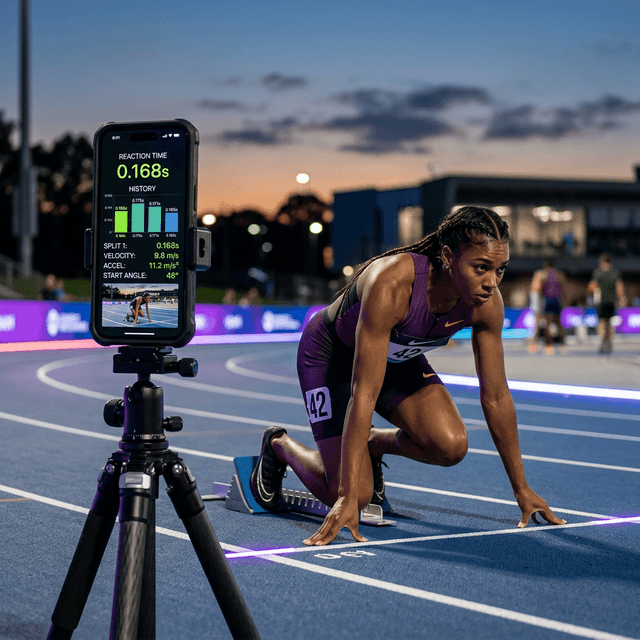
The core issue is that start response is a video-detectable moment—your first motion is visible—so a phone camera is a surprisingly powerful sensor.
What you need is:
- A clear start cue
- A clear view of the athlete’s body
- A consistent definition of “first movement”
- A repeatable way to timestamp cue vs movement
[!IMPORTANT] : Stop guessing, start measuring. Your phone's camera is the only sensor you need for elite-level reaction data.
Introducing Reaction-Pro (SpeedTrackr): reaction timing with just your phone camera
Reaction-Pro is built for athletes and coaches who want real sprint-start reaction measurements without expensive equipment.
With Reaction-Pro, you can:
- Measure block start reaction time or 3-point start reaction time
- Use only a phone camera
- Track progress across sessions
- Reduce guesswork and measure what actually changes
Why this matters (especially for under-resourced athletes)
Not everyone has access to:
- timing gates
- force plates
- high-speed lab setups
But almost everyone has access to a smartphone camera.
Reaction-Pro bridges that gap: it makes reaction and start-response measurement accessible, repeatable, and sprint-specific.
How to set up Reaction-Pro for accurate start reaction time
1) Camera placement (simple rule: see the athlete clearly)
- Place the camera side-on (best for first movement visibility)
- Keep the full body in frame if possible
- Stable placement (tripod if you have one, or lean the phone on a bag)
2) Cue choice
- Use a clear beep or clap
- Avoid noisy environments if possible
- Keep the cue consistent across sessions
3) Define “first movement” once—and stick to it
Examples of consistent definitions:
- first hand movement (3-point)
- first visible hip rise
- first foot/ankle shift
The goal isn’t perfection—it’s consistency.
4) Track enough reps to see real change
Do 6–10 quality reps and look at:
- average reaction time
- best reaction time
- variance (how scattered the reps are)
Variance is often the hidden limiter.
A practical 2-week Reaction-Pro micro-plan
Use this if you want a simple, measurable routine.
Week 1 (build consistency)
2 sessions
- Warm-up + 2–3 build-ups
- 8 start reps (randomized cue)
- Full rest (1.5–3 min)
- Track reaction time for every rep
Goal: tighten the spread.
Week 2 (push speed under the same rules)
2 sessions
- Same setup
- 10 start reps
- Keep technique strict
- Compare average + variance vs Week 1
Goal: improve mean while keeping the spread tight.
The takeaway
Reaction time isn’t magic, but it’s measurable—and trainable—when you:
- train it in sprint-specific contexts
- measure it consistently
- care about variance, not just a single “best” rep
If you want to stop guessing and start tracking your start response with real data, try Reaction-Pro inside SpeedTrackr—and measure your block or 3-point start reaction time using only your phone camera.
Want to use Reaction-Pro today?
Open SpeedTrackr → Reaction-Pro → set your start type (blocks or 3-point) → record → track your reps.
Train what matters. Measure what changes.
Ready to find your weak link? Analyze your start with our Sprint Technique Analysis today.
Put it into practice.
Turn this insight into numbers — time your sprints, measure your jumps, and track your reaction time with SpeedTrackr for Android.
Free 4-week sprint plan.
Join the weekly sprint newsletter and get a research-backed 100m training blueprint — acceleration, max velocity, plyometrics, and speed endurance. Instant download.
Weekly, no spam. Unsubscribe anytime.